Global Infrastructure Growth Puts Construction Efficiency in Focus
 Oct 23, 2026|
New industry reports highlight rising demand and delivery pressures, making project-specific formwork and shoring planning increasingly relevant.
Global construction faces a growing challenge: delivering more infrastructure while managing limited resources, rising costs and demanding schedules.
On 20 October 2026, the Global Cement and Concrete Association published findings from an Oxford Economics report forecasting that global construction activity will grow by more than 70% between 2025 and 2050, reaching US$16.6 trillion. Housing and infrastructure shortages, climate adaptation and high-tech development are among the drivers identified.
Meanwhile, AI infrastructure is adding pressure in specific construction markets. Turner & Townsend's Data Centre Construction Cost Index 2026–27 found that 81% of respondents reported constrained skilled labour availability in their region, with mechanical, electrical and plumbing trades particularly sought after. These findings concern data centre delivery, but they also illustrate the resource pressures that project teams must consider when planning construction.
For concrete contractors, these developments reinforce a practical priority: planning how work will be executed before committing to equipment and materials.
Formwork and shoring are an important part of that process. Panel layouts, connection details, handling arrangements and stripping sequences all need to fit the structure and the construction programme. Assessing these requirements early gives contractors a clearer basis for comparing systems and organising site operations.
The purchase price is only one part of the calculation. Assembly labour, lifting requirements, maintenance, transport and planned reuse also influence the overall cost of a formwork package.
Different projects therefore call for different solutions. Repetitive residential structures may provide opportunities for aluminium formwork, while bridges, water infrastructure and specialised concrete structures may require purpose-designed steel formwork. Plastic formwork can also be evaluated for suitable applications, subject to the required geometry, concrete pressure and support arrangement.
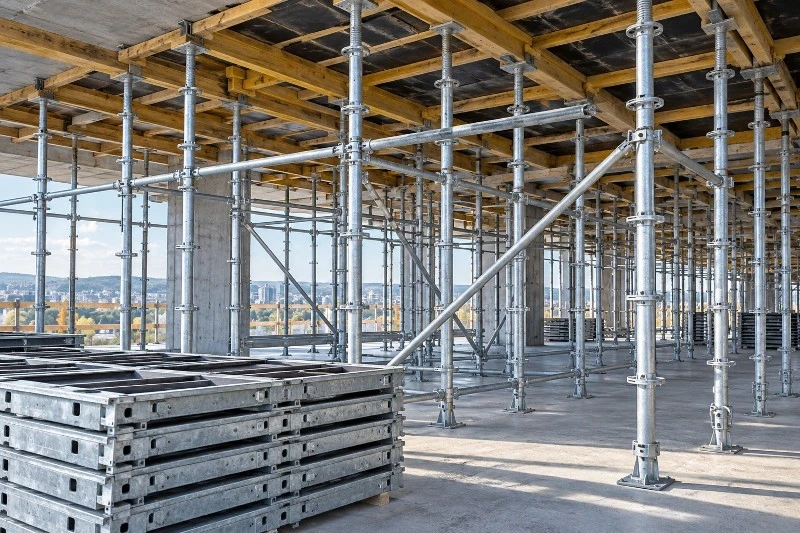
Shoring must be planned alongside the formwork. Ringlock systems and adjustable steel props need to be selected and configured for the project's loads, heights, stability requirements and construction sequence.
For precast operations, the same approach extends to the production process. Beam moulds, casting beds, hydraulic opening and closing mechanisms, and handling arrangements should be considered together against production targets and available factory space.
Tianjin Tiantai Formwork Co., Ltd., operating under the TITAN FORMWORK brand, supplies formwork, scaffolding, shoring and precast production solutions. Its product range includes steel, stainless steel, aluminium and plastic formwork, ringlock scaffolding, adjustable steel props, and customised beam mould and casting bed systems.
TITAN FORMWORK's approach starts with the project: understanding the structure, required concrete finish, available labour, handling conditions and delivery requirements before recommending a product configuration.
As international construction demand evolves, early coordination between contractors and equipment suppliers can help turn broad investment plans into practical site arrangements. For formwork and shoring procurement, the essential question is how well the complete system supports the work that needs to be delivered.