





Key Points for the Safe Management of Socket-Type Disk-Coupler Steel Pipe Scaffolding
 Jun 10, 2026|
 一. Characteristics of Socket-Type Disk-Coupler Steel Pipe Scaffolding
1. High load-bearing capacity and excellent safety. The load-bearing structure is made of Q355b high-strength steel, offering 1.5 to 2 times the load-bearing capacity of traditional Q235b scaffolding. A single upright can support up to 10 tonnes, and the load-bearing capacity in destructive load tests reaches 18–19 tonnes
2. Simple and rapid erection, with high construction efficiency. A single person with a hammer can erect the scaffolding quickly, saving on overall labour hours and labour costs.
3. Long service life. Disk-coupler scaffolding utilises a hot-dip galvanised surface treatment process, with the product covered in a zinc layer both inside and out, providing excellent rust resistance. The service life is typically over 10 years, and under normal use, it can easily last 15–20 years.
4. Accessories are not easily lost. Disk-coupler scaffolding has no loose components; even the smallest pins are attached to the coupling joints and are difficult to remove.
5. Good flexibility. Although the vertical, horizontal and diagonal members of disk-coupler scaffolding are fixed-modulus components, the system is currently available with accessories such as double-support channel steel, tripods and short couplers, allowing for flexible erection according to on-site conditions and construction plans.
6. Simple and attractive. The internal and external hot-dip galvanised surfaces of the disk-coupler scaffolding have a silvery appearance. The components are manufactured to a higher precision than traditional scaffolding, resulting in a structure that is perfectly straight and level, ensuring both safety and an attractive appearance.
二. Main components of socket-type disk-coupler scaffolding
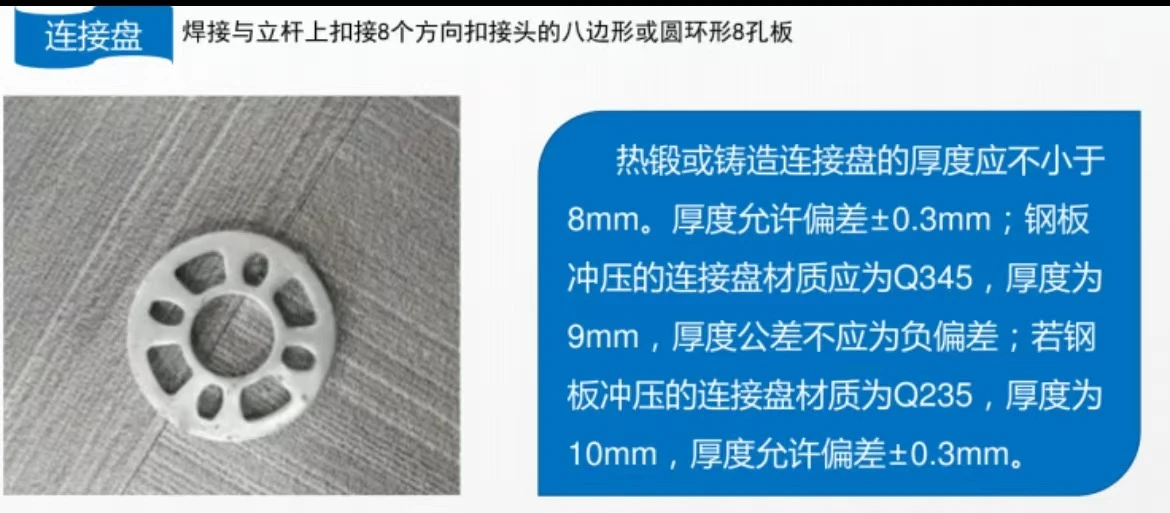
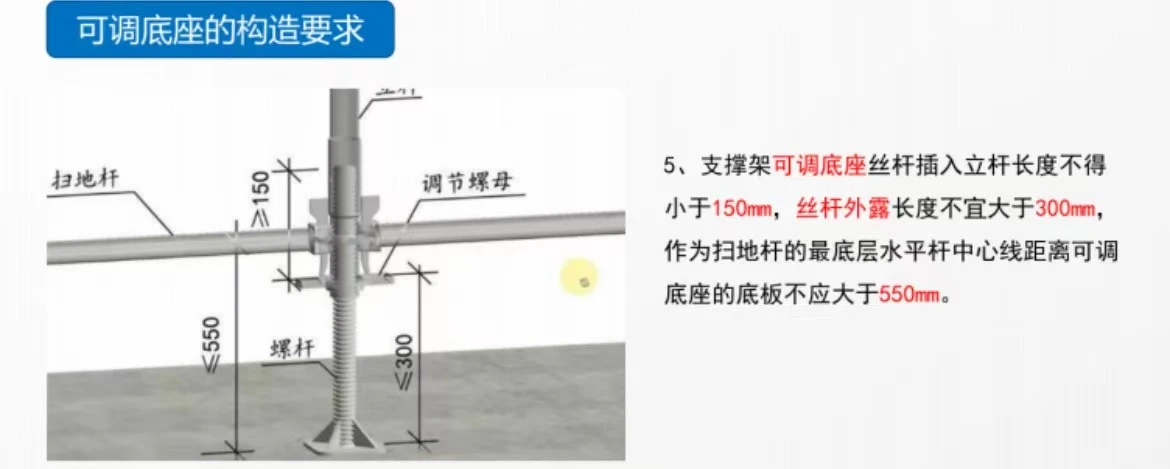
Depending on the outer diameter of the upright, they can be classified as standard type (Type B) and heavy-duty type (Type Z). Scaffolding components, materials and their specifications shall comply with the provisions of the current industry standard JG/T 503, Socket-type Disk-coupling Steel Pipe Scaffolding Components
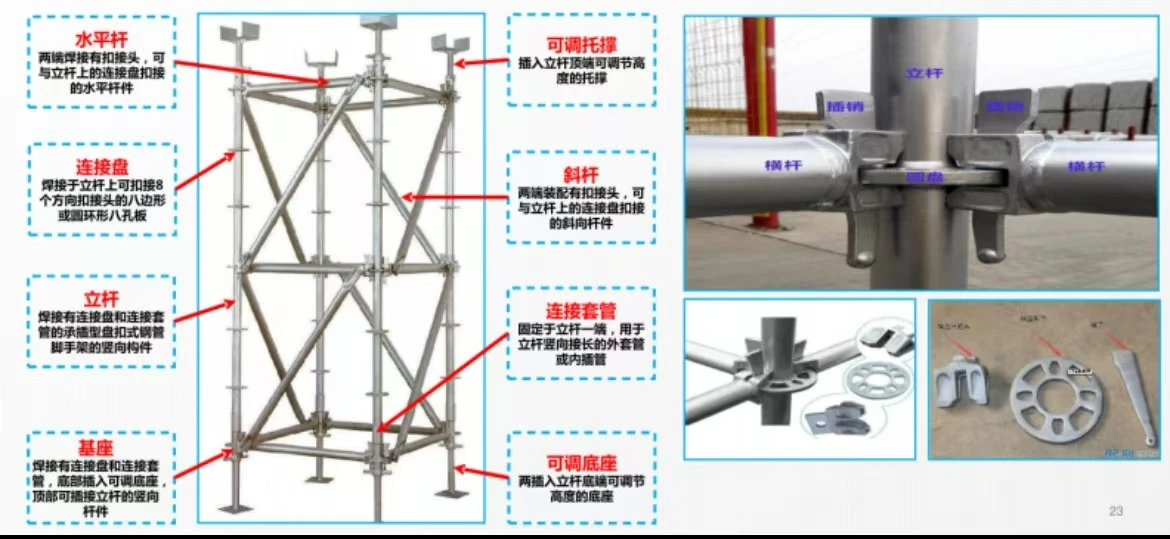
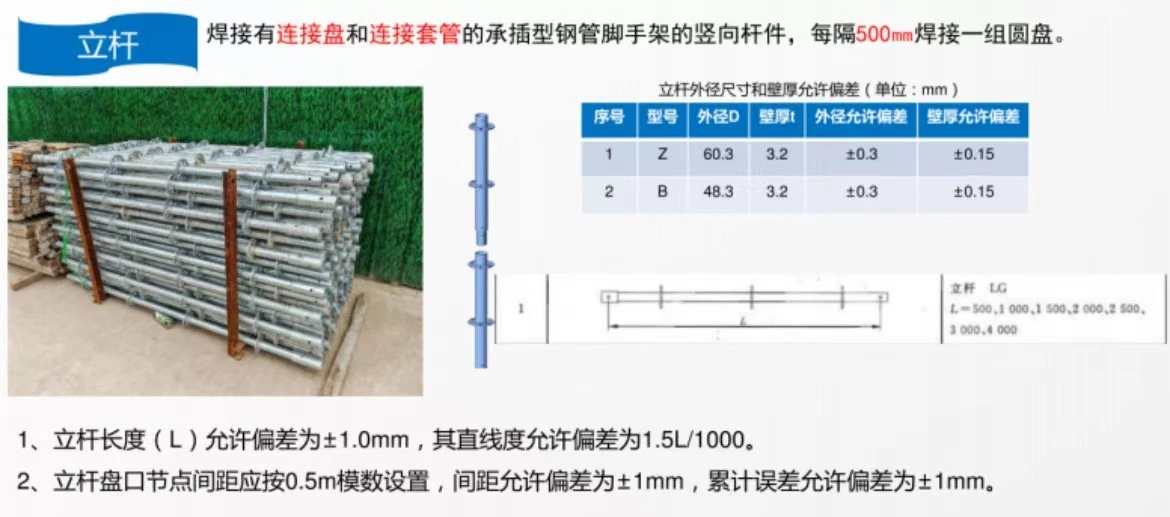
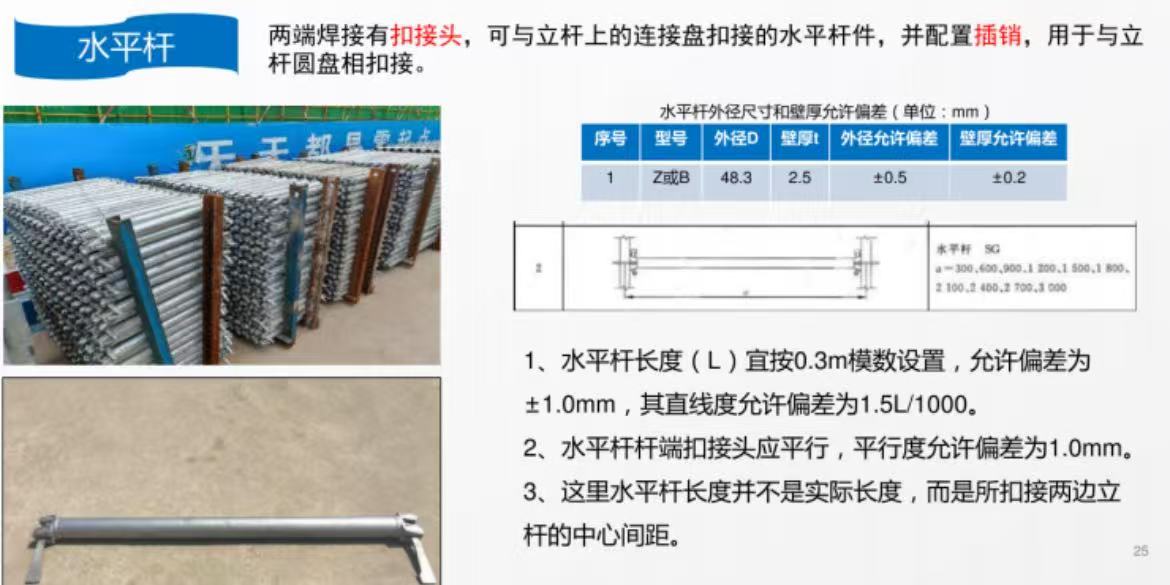
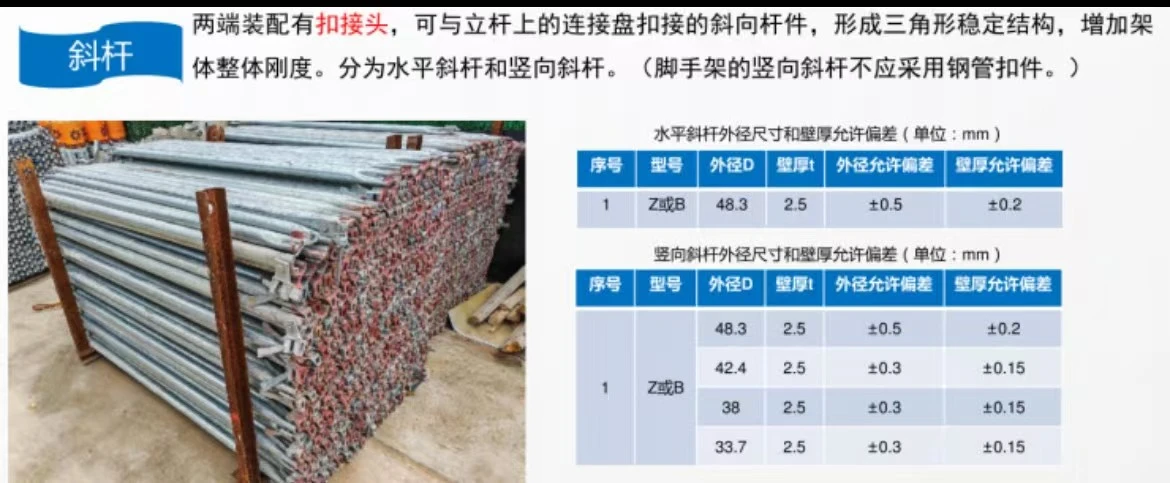

三. Management of High-Risk Projects Involving Socket-Type Disk-Coupler Scaffolding
1. Formwork Works and Shoring Systems
1)Scope of projects with significant hazards:
Concrete formwork shoring works where the erected height is 5 m or above, or the span is 10 m or above, or the total construction load (design value of the basic load combination, hereinafter referred to as the design value) is 10 kN/m² or above, or the concentrated line load (design value) is 15 kN/m or above, or where the height exceeds the horizontal projection width of the support and there are no connecting members.
2) Scope of high-risk works exceeding a certain scale:
Erection height of 8 m or more, or erection span of 18 m or more, or total construction load (design value) of 15 kN/m² or more, or concentrated line load (design value) of 20 kN/m or more.
2. Scaffolding Projects
1) Projects classified as having a relatively high degree of risk:
(i) Ground-supported steel tube scaffolding projects with an erection height of 24 m or more (including scaffolding for light wells and lift shafts)
(ii) Cantilevered scaffolding projects.
(iii) Unloading platforms and working platforms.
(iv) Non-standard scaffolding projects.
2) Projects involving high-risk construction work exceeding a certain scale:
(i) Projects involving ground-supported steel tube scaffolding with a height of 50 metres or more.
(ii) Projects involving cantilevered scaffolding with a height of 20 metres or more when erected in sections.
3. Identification of high-risk projects involving excessive loads and those exceeding a certain scale
1) Calculation method for concentrated line loads (design values):
Design value of concentrated line load = Standard value of permanent load (dead weight of reinforced concrete + dead weight of formwork timber) × Partial factor for permanent load 1.3 + Standard value of construction variable load × Partial factor for variable load 1.5 (According to Clause 8.2.9 of the 'Unified Standard for Reliability Design of Building Structures' GB50068-2018, the partial factor y for permanent actions is taken as 1.3, and the partial factor y for variable actions is taken as 1.5). Take 1.3; partial factor for variable actions y. Take 1.5).
Calculated over a length of one metre, self-weight of reinforced concrete = beam cross-sectional area × 1 m × 25.5 kN/m³ (when calculating concentrated line loads, the is taken as 1.5 kN/m³, and concrete as 24 kN/m³). Self-weight of formwork timber = (h + h + b) × 1 m × 0.5 kN/m (when calculating concentrated line loads, the value is taken as 0.5 kN/m). The design value of the concentrated line load is taken as 20 kN/m, the beam cross-sectional area is b × h. According to the following formula: Linear load = 1.3 × lb × h × 25.5 + 0.5 × (b + h + h) + 1.5 × b × 2.5 ≤ 20, it follows that b × h = 0.51 m, meaning that when the beam cross-sectional area reaches 0.51 m², the project is classified as a 'high-risk' project requiring expert assessment. By the same token, when the beam cross-sectional area reaches 0.35 m², the project is classified as a 'major-risk' project.